
Publications
You can also find my articles on my Google Scholar profile.
Preprints
Ensemble reconstruction of the Greenland Ice Sheet evolution through the last deglaciation
Evaluating 3,000 simulations against observations gives a constrained reconstruction of Greenland through the last deglaciation, with a contribution of −5.75 m of sea-level equivalent at the Last Glacial Maximum.
Fast approximation of Antarctica's GIA response to future ice melt with 3-D Earth structure
In coupled simulations of the next five centuries, FastIsostasy closely matches the 3-D GIA model Seakon and performs better than overly simplified GIA models.
Highlighting processes underlying the stability and hysteresis of the Antarctic Ice Sheet
An adaptive forcing captures previously unidentified bifurcations of the Antarctic Ice Sheet. We describe the perimeter feedback, a positive feedback on the mass balance of marine ice sheets during both retreat and regrowth.
Published
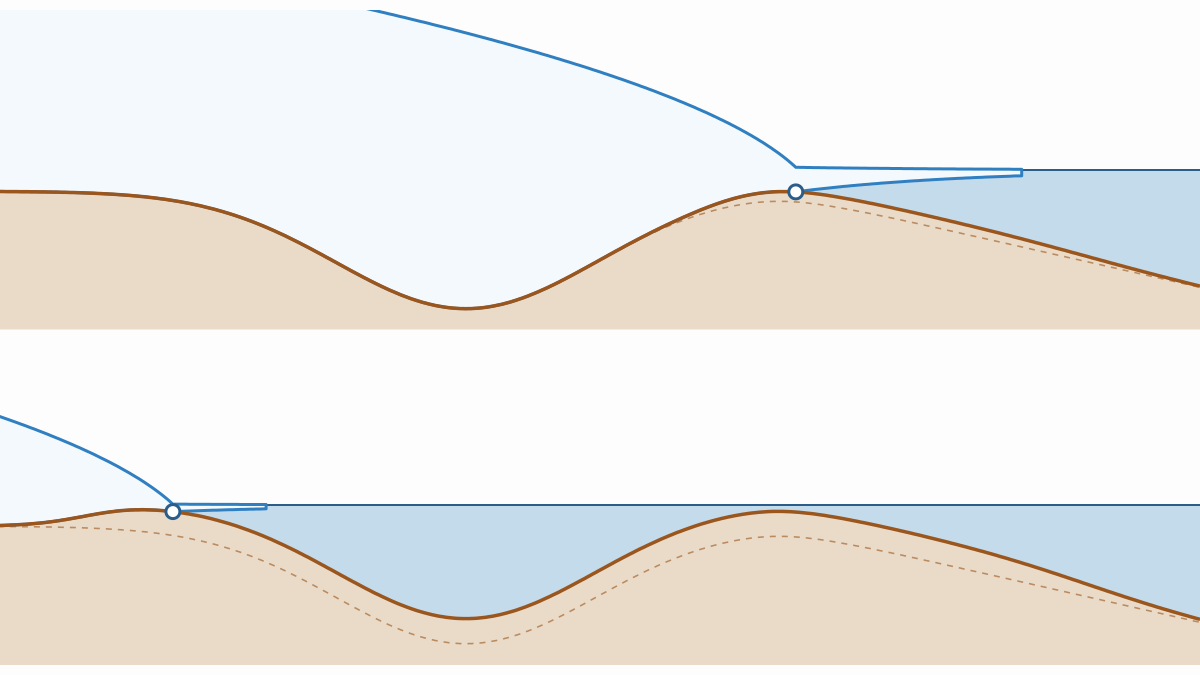
Antarctic marine-based ice destabilized when warming outpaces solid-Earth feedbacks
When warming outpaces bedrock rebound, the Recovery and Aurora basins (about 7 m of sea level together) can collapse at up to 0.5 °C less warming than equilibrium simulations suggest. West Antarctica shows no such effect.
Parameterizing tidal-water intrusions in long-term Antarctic ice-sheet projections
A simple way to represent tidal intrusion of ocean water upstream of the grounding line in continental-scale models. More intrusion means more grounding-zone retreat and a larger sea-level contribution.
Chaotic fluctuations in Greenland ice streams limit predictability of ice sheet collapse
Two interacting ice streams in northern Greenland alternate between fast flow and stagnation. For the same warming, the timing of collapse can differ by tens or hundreds of thousands of years.
Exploring the Mid-Pleistocene transition with a simple physical model
In the PACCO model, sustained regolith removal changes the period and amplitude of glacial cycles at the right time to match the Mid-Pleistocene transition.
Hysteresis of the Greenland ice sheet from the Last Glacial Maximum to the future
Greenland’s hysteresis persists across almost the whole range from glacial to warmer climates. Besides the known warm threshold, there is a second one in cold climates, driven by ocean warming and marine ice-sheet instability.
A simple physical model for glacial cycles
PACCO is a conceptual model of climate and Northern Hemisphere ice sheets with a physical basis. Ice-sheet dynamics and a delayed isostatic response are enough to produce resonance around 100 kyr.
TransitionsInTimeseries.jl: A performant, extensible and reliable software for reproducible detection and prediction of transitions in timeseries
A Julia package to detect and predict transitions in time series.
FastIsostasy v1.0 – a regional, accelerated 2D glacial isostatic adjustment (GIA) model accounting for the lateral variability of the solid Earth
Simulates 100,000 years of high-resolution bedrock displacement in minutes on a single CPU, including lateral variations of the solid Earth. Compared to a 3D GIA model over the last glacial cycle, the error is below 5% on average and 16% at most.
Time-scale synchronisation of oscillatory responses can lead to non-monotonous R-tipping
Forcing a system faster can make it tip in some cases and prevent it from tipping in others. Here, the reason is the peak synchronisation of oscillatory responses on different time scales.
PhD thesis
Stability of the Antarctic ice sheet
Marine ice-sheet instability, and glacial isostatic adjustment, the negative feedback that can slow it but is often poorly represented in ice-sheet models.